MTI - Magneto-thermal instability in galaxy clusters
The intracluster medium of galaxy clusters (ICM) is a hot and dilute plasma which comprises a substantial fraction of the total mass of the cluster (about 15%, several times more than the mass contained in stars!). Because of its high temperature ($\sim 10^8$ K) the ICM is essentially a fully ionized plasma (mostly made of ionized hydrogen) which emits X-ray radiation. What makes it interesting compared to other plasmas in the Universe is that the ICM is characterized by an extreme hierarchy of scales: electrons and ions gyrate around magnetic fields following very tight orbits (of the order of nanoparsec in size), while the typical distances they travel before scattering against one another is of the order of tens of kiloparsecs, and the overall size of these clusters is of the order of a megaparsec. So, overall 15 orders of magnitude! This makes studying these objects very difficult.
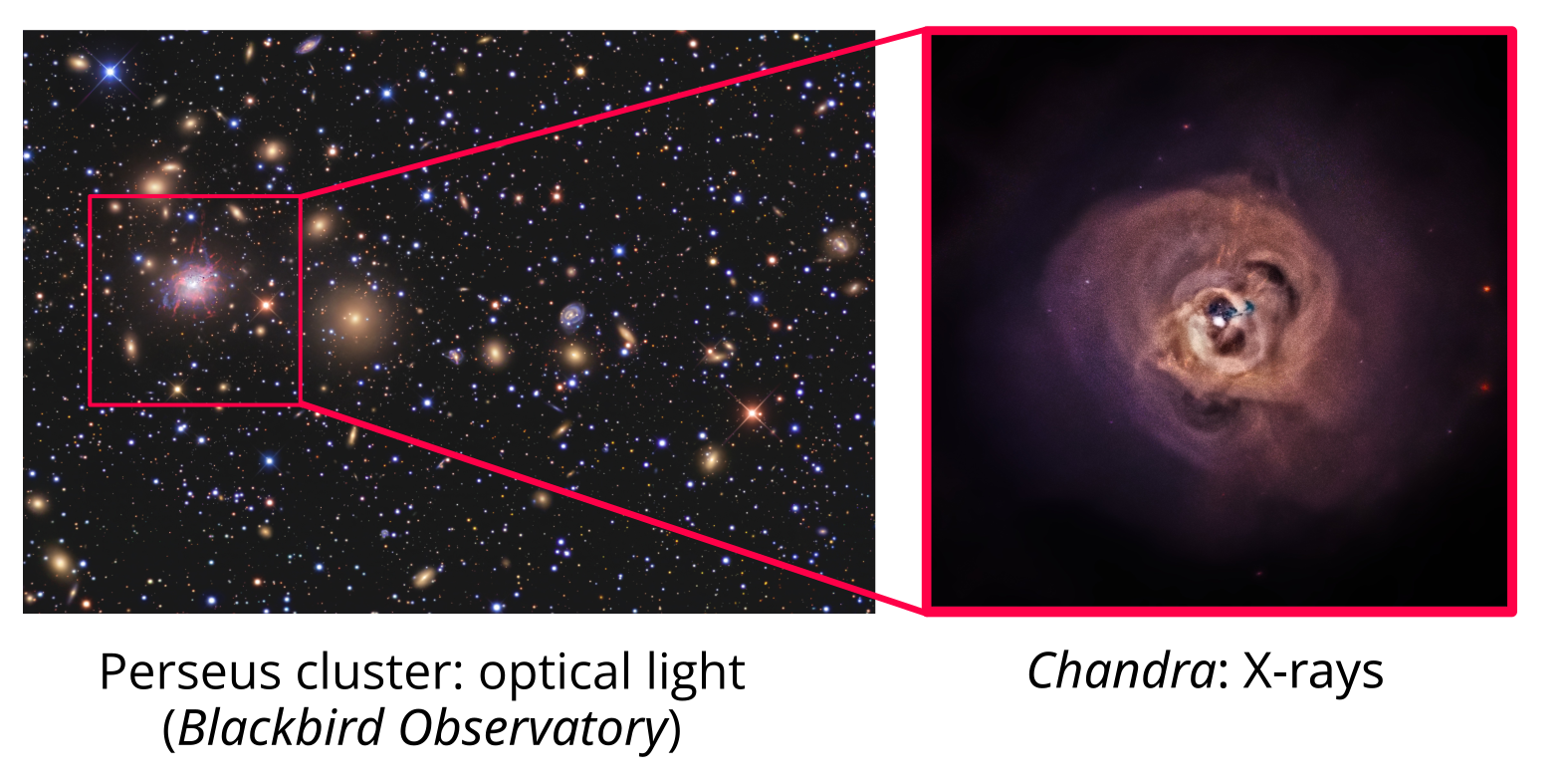
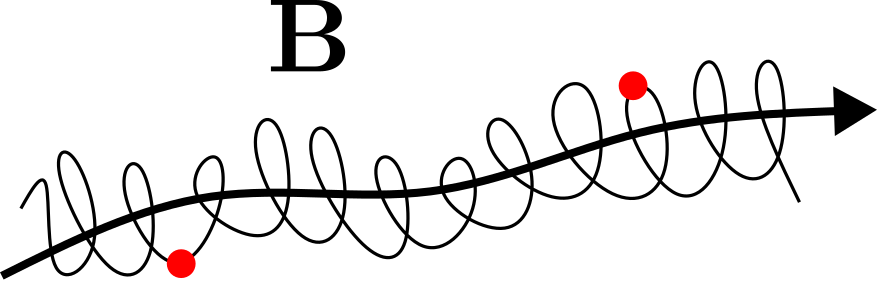
A consequence of this hierarchy of scales is that transport processes (like heat diffusion, which is mainly due to thermal electrons moving around in the plasma) also follow the direction of magnetic fields, and so they are anisotropic. This property triggers a class of buoyancy instabilities that can destabilize the plasma (even though it is formally convectively stable according to the Schwarzschild criterion), and bring about a state of turbulence. One of them is the magneto-thermal instability (MTI), which may be active in the periphery of galaxy clusters, and that has been the main focus of my PhD research. During my PhD, I used a mix of numerical simulations and analytical arguments to construct a general theory that explains the MTI saturation mechanism and provides scalings and estimates for the turbulent kinetic energy, which can be compared with data from observations.
Physics of the MTI
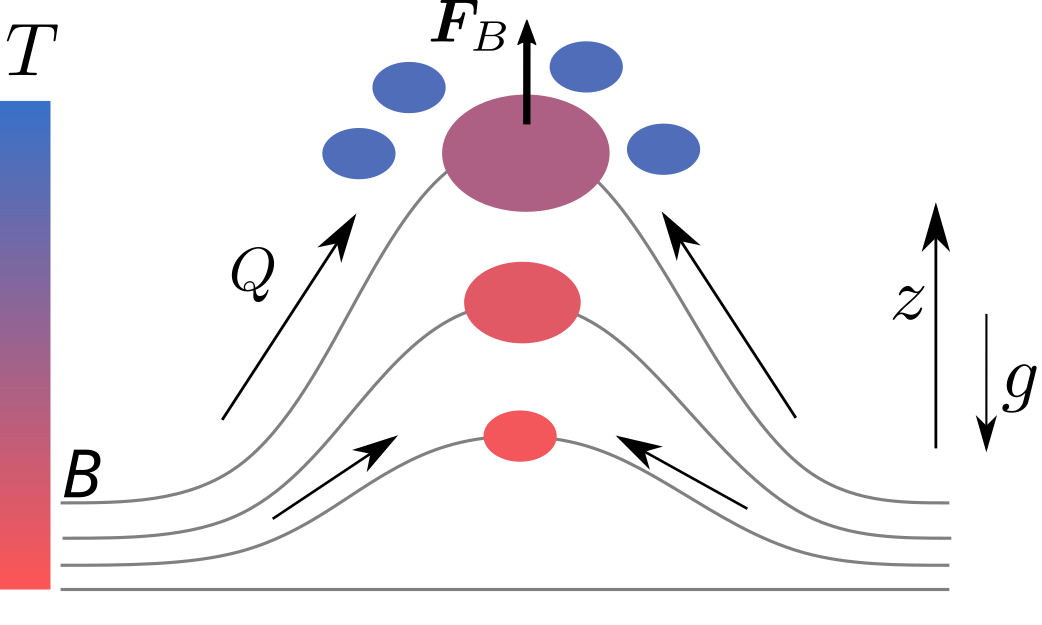
The basic instability mechanism of the MTI is relatively intuitive. Consider this idealized scenario of vertically stratified plasma, with a vertical temperature gradient aligned with the gravitational acceleration $\bm g$ (i.e. cold plasma sits upon hot plasma). Moreover, let us place a horizontal magnetic field and assume that the heat can only flow along the field lines. Initially, magnetic field lines are isotherms (there are no fluxes of heat) and the system is at equilibrium. We now introduce a small perturbation, displacing a fluid blob slightly upwards from its original position: because of the frozen-in condition, the magnetic field will be dragged along with it and thus the blob will remain thermally connected to the warm fluid at lower altitudes as heat flows along the field lines. In the limit of fast conduction, the perturbation will be isothermal rather than adiabatic. But to come into pressure equilibrium with its new surroundings, the blob’s density must decrease, because the neighbouring fluid is cooler. Now, being lighter, the blob will rise, the local magnetic field becomes even more aligned with the temperature gradient, further enhancing the heat transport, and initiating instability (Balbus, 2000).
For very weak magnetic fields and negligible viscosity/resistivity the maximum growth rate of the MTI approaches $$ \begin{align*} \omega_T = \left( - g \frac{\mathrm{d} \ln T}{\mathrm{d}z} \right)^{1/2} \end{align*} $$ which is independent of the thermal diffusivity $\chi$. Another relevant frequency is the Brunt-Väisälä frequency $$ \begin{align*} N = \left( \frac{g}{\gamma} \frac{\mathrm{d} \ln p \rho^{-\gamma}}{\mathrm{d}z} \right)^{1/2} \end{align*} $$ which is the typical frequency associated with stable oscillations or convective instability according to the classic Schwarzschild criterion. In the periphery of galaxy clusters the MTI and buoyancy timescales are comparable and of the order of $\sim 600$Myr, which is much less than the Hubble time and would give the MTI ample time to develop. The MTI is never entirely stabilized by a strong entropy stratification, but its growth is slower if $N/\omega_T \gg 1$.
The thermal diffusivity $\chi$ and the MTI frequency $\omega_T$ can be combined to obtain a “conduction length” which is of particular importance: $$ \begin{align*} l_{\chi} = \sqrt{\chi/\omega_T}, \end{align*} $$ that physically represents the largest scale at which thermal conduction will be efficient in driving the instability.
Numerical methods
In my PhD work I focused on the subsonic and small-scale dynamics of the MTI, with the aim of clarifying its nonlinear saturation, which had not been established in the literature yet. For this reason, I decided to adopt the Boussinesq approximation of the fully compressible MHD equations to describe the evolution of a small Cartesian block of plasma in the presence of background gradient in both entropy and temperature (imagine this box located at a given spherical radius $R_0$, with the vertical direction aligned with $R$). The Boussinesq approximation is often employed in studies of thermal convection both in astrophysical flows (e.g. the interior of stars), or in geophysical flows (ocean circulation).
The numerical simulations were carried out with a pseudospectral Boussinesq code, SNOOPY (Lesur 2015), which I modified to include anisotropic heat conduction and a supertime stepping algorithm to speed up the integration of parabolic diffusive terms (which in our regime of interest are dominated by thermal diffusion). This choice allowed me to perform an extensive sampling of the parameter space, as opposed to standard fully-compressible MHD codes for astrophysical flows which are less flexible.
Results
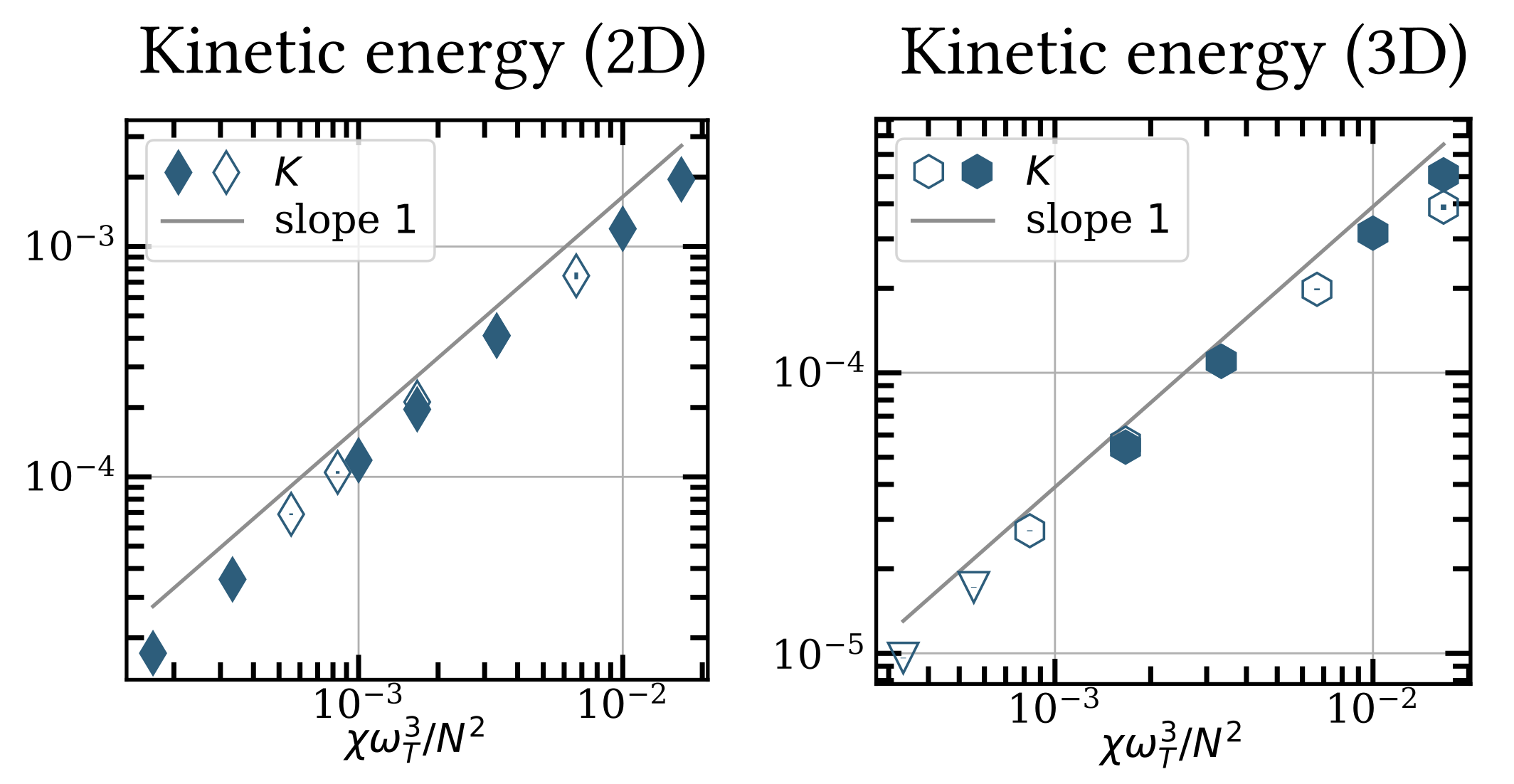
The results of this project showed that the MTI exhibit a rich phenomenology, with different saturation routes in 2D and 3D. Despite this difference, the steady state of turbulence reached after the exponential growth of the instability follows scaling laws that are in common between 2D and 3D.
Two-dimensional simulations
In 2D I was able to connect the saturation of the MTI to the rich literature which exists on stably stratified 2D hydrodynamic turbulence (Bolgiano, 1959; Obukhov, 1959).
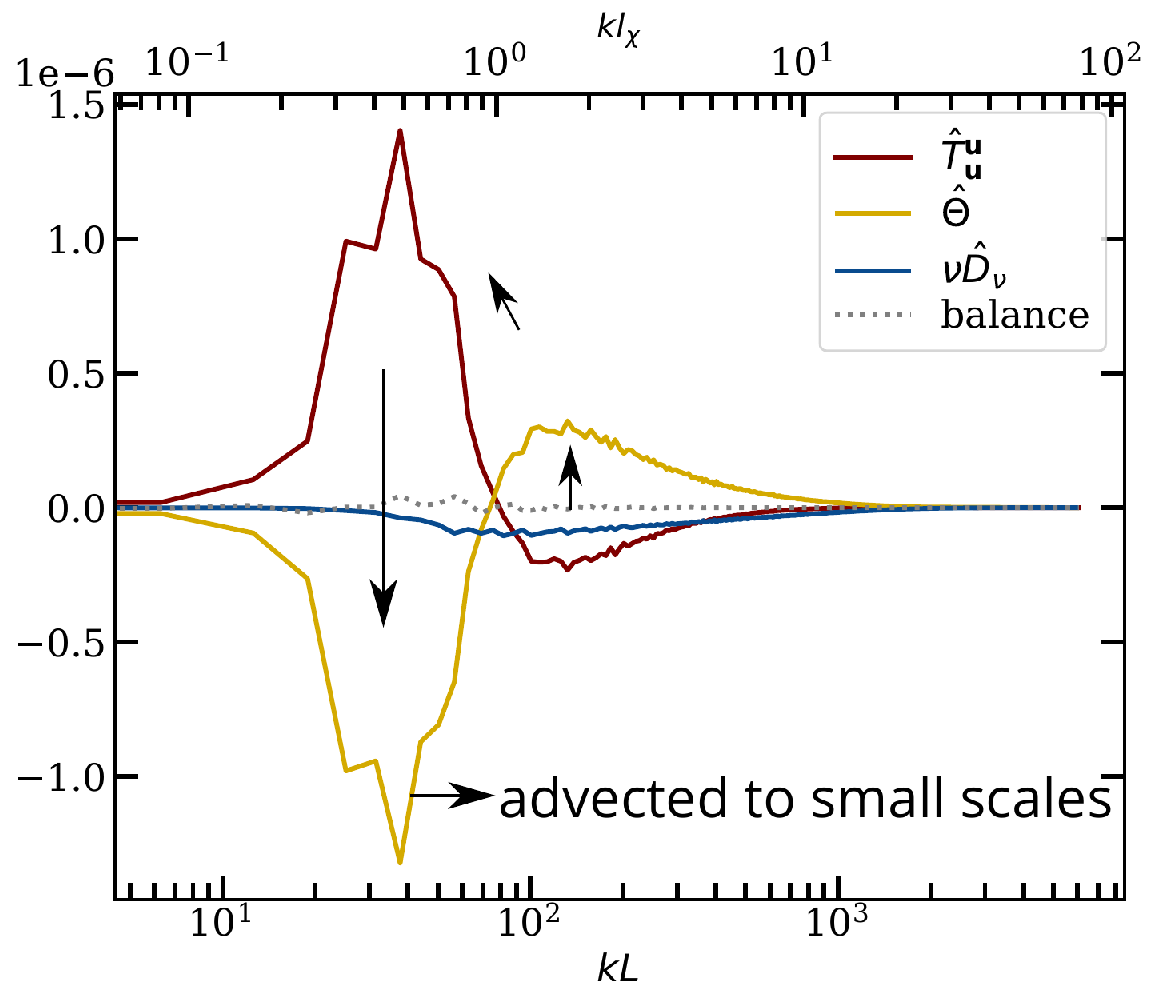
As is well known, the stable entropy stratification leaves small scales alone for the most part (there can exist the usual inertial range of forced 2D turbulence), and instead works most effectively on long scales larger tha critical large scale (the Ozmidov scale), where fluid motions are constrained to undergo buoyancy oscillations and consist mostly of motions in the horizontal direction. Moreover, buoyancy can arrest the inverse energy cascade at this critical scale, by imposing an effective energy sink or drag. More precisely, it establishes an energy flux-loop: kinetic energy is sent up to large-scales by the inverse cascade; it is then converted into density fluctuations via the excitation of g-modes; and finally these fluctuations are nonlinearly advected back down to smaller scales, where they are dissipated via thermal diffusion (Boffetta et al., 2011).
The physical picture that emerges from the simulations provides us with a natural energy removal mechanism at large scales that we can use to estimate the total kinetic energy at saturation, leading precisely to the scaling of $K \sim \chi \omega_T^3 / N^2$.
Three-dimensional simulations
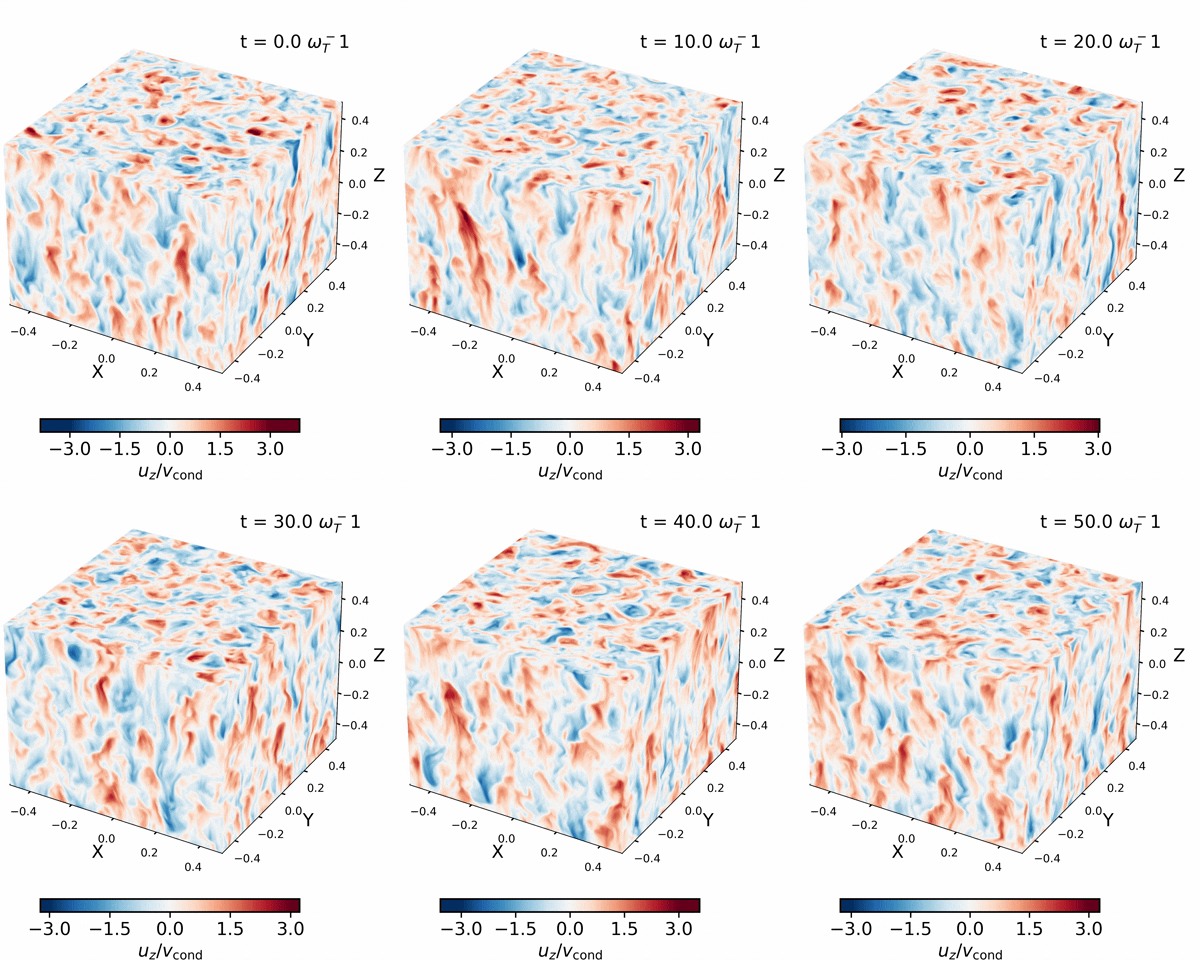
The MTI turbulence is buoyancy-driven, in the sense that energy is injected into the flow on a wide range of scales in the form of density fluctuations. In this respect, it shares similarities with other buoyancy driven flows, such as Rayleigh-Benard convection or bubbly flows, where energy is transferred from buoyancy to kinetic fluctuations, rather than in the opposite direction, as would be the case in forced stably-stratified turbulence. On small scales the energy injected by the MTI is locally dissipated by thermal diffusion, but on longer scales the injected energy is transferred, through the buoyancy coupling term, into kinetic fluctuations. These, in turn, are either locally dissipated by viscosity, or converted into magnetic fluctuations that cascade down to the very short resistive scale.
Application to galaxy clusters
The scaling laws for the turbulent energy levels derived can be applied to the ICM and compared to actual observations of galaxy clusters. By plugging in reasonable estimates of the thermal diffusivity $\chi$, the MTI frequency $\omega_T$ and the Brunt-Väisälä frequency $N$, I found that the resulting turbulent levels are in rough agreement with observed values in the periphery of galaxy clusters ($u_{\mathrm{rms}} \simeq 100$ km/s), provided that thermal conductivity is suppressed by a factor of $\approx 1∕10$, wwhich is in line with values obtained from studies of kinetic microinstabilities in weakly collisional plasmas.
Publications related to this project
1. ‘‘Magneto-thermal instability in galaxy clusters - I. Theory and two-dimensional simulations’’, Perrone Lorenzo Maria, Latter Henrik, Monthly Notices of the Royal Astronomical Society, Volume 513, Issue 3, pp.4605-4624. ADS
2. ‘‘Magneto-thermal instability in galaxy clusters - II. three-dimensional simulations’’, Perrone Lorenzo Maria, Latter Henrik, Monthly Notices of the Royal Astronomical Society, Volume 513, Issue 3, pp.4625-4644. ADS