Neutrino-electron magnetohydrodynamics in an expanding Universe
In this project I derived a new model for neutrino-plasma interactions in an expanding universe that incorporates the collective effects of the neutrinos. This project was something of a spin-off of my PhD that I understook at the Rutherford Appleton Laboratories jointly with the Department of Atomic and Laser Physics at the University of Oxford.
Neutrinos in the Universe
Neutrinos are very lightweight elementary particles that interact very weakly with normal matter. Their rest mass is actually still undetermined! Neutrinos play an important role in many astrophysical contexts: they are produced in abundance in core-collapse supernovae, and by thermonuclear reactions in the interiors of stars; moreover, relic neutrinos that originated in the early universe are thought to permeate all space and can provide valuable information on the cosmology of the Big Bang.

Neutrinos interact with other plasma constituents through the electroweak force and its associated charged and neutral currents. Even though the interaction cross-section of the neutrinos with matter is extremely small, the many-body interaction between neutrinos and electrons can drive plasma instabilities and generate strong magnetic fields. The self-consistent generation of electromagnetic fields through collective interactions is of particular relevance to the problem of cosmic magnetogenesis, and may offer a possible solution to the generation of primordial magnetic fields in the early universe.
The semi-classical limit
Neutrino-plasma interactions can be studied in the semi-classical limit, where the effects of neutrino-electron nonlinear interactions can be included in magnetohydrodynamic (MHD) models by making use of the formal analogy between the electromagnetic and weak interaction.
In fact, the interaction Lagrangian for a single neutrino of type $\nu$ with velocity $\bm v _\nu$ in a background made of particles of species $s$ (where $s$ refers to either electrons, protons or neutrons) is
$$ \begin{align} \mathcal{L}_{\mathrm{int},\nu s}^{(W)} = -q^{(W)} _{s \nu} \left( n_s - \frac{\bm{N}_s \cdot \bm v _\nu}{c^2} \right) \end{align} $$
where $q^{(W)} _{s \nu}$ is the effective charge of the weak interaction, and $n_s$ and $ \bm{N}_s$ are the number and current density of species $s$ in the laboratory frame, respectively. This interaction Lagrangian is formally identical to that of a charged particle in the presence of an electro-magnetic field.
In addition to the force induced by the background electrons on the neutrinos, the neutrino distribution can itself affect the motion of the electrons through a macroscopic ponderomotive force, representing the collective force of the neutrinos on plasma particles. This effect is analogous to the force exerted by an electromagnetic pulse on the plasma, as is the case in laser wakefield acceleration. This additional term appears in the momentum and induction equations, depends on the number density and the velocity of neutrinos, but not on the magnetic field strength, and can therefore generate a primordial magnetic seed.
Neutrino battery
In my work, I used the semi-classical limit to write the evolution equations of neutrino and plasma particles in an expanding Universe described by the flat Friedmann-Robertson-Walker (FRW) metric.
$$ \begin{align*} d s^2 = dt^2 - a^2 (t) \sum_{i=1,2,3} (d x^i)^2, \end{align*} $$
I then integrated the Vlasov-Maxwell equations to obtain fluid moments of the distribution function. The fluid equations were then specialized to describe the interaction of an electron-positron pair plasma with neutrinos shortly after the QCD crossover, and a neutrino-electron plasma in the limit of slow ions after the electron-positron annihilation. In both scenarios, I found that an additional term that represents the collective force of the neutrinos on the plasma particles appears in the induction equation: this “neutrino battery” term does not depend on the magnetic field strength, and describes the generation of primordial magnetic fields in the Universe due to the presence of misaligned density gradients between the neutrino and electron population.
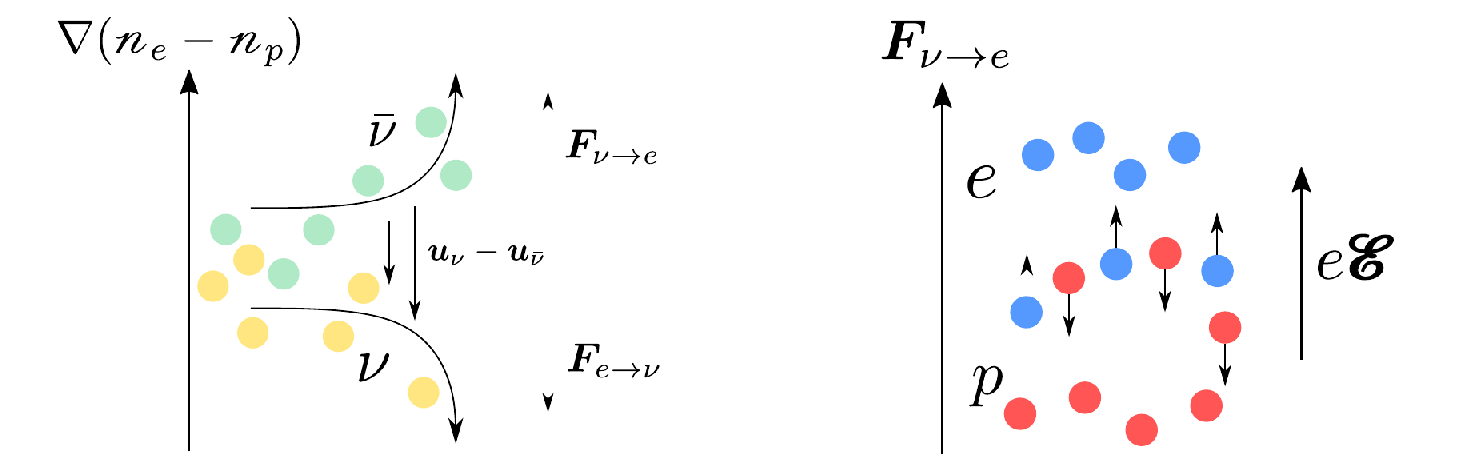
Estimates of the resulting magnetic field levels are consistent with constraints derived from cosmic microwave background anisotropy and current magnetic fields in galaxy clusters.
Contrary to the usual Biermann battery, the neutrino battery does not vanish if the plasma remains barotropic during the QCD crossover (as one would expect if the QCD is not, in fact, a first-order phase transition), since the turbulent fluctuations in the thermodynamic properties of the plasma generated at the phase transition will not be perfectly correlated with those of the neutrino field. The relevance of this novel mechanism to explain magnetogenesis also lies in the fact that it does not require “exotic” physics (i.e., outside of the Standard Model).
Publications related to this project
1. ''Neutrino-electron magnetohydrodynamics in an expanding universe ‘’, Perrone, L. M.; Gregori, G.; Reville, B.; et al., Physical Review D, Volume 104, Issue 12, article id.123013. ADS