Reduced kinetic model of scrape-off layer in Tokamaks
In this project, which I undertook as a Master student at the Swiss Plasma Center, EPFL, I derived an analytical model to describe the physics of the scrape-off layer of fusion devices (tokamaks) based on the drift-kinetic approximation and on a polynomial expansion of the plasma distribution function.
Plasma fusion and scrape-off layer
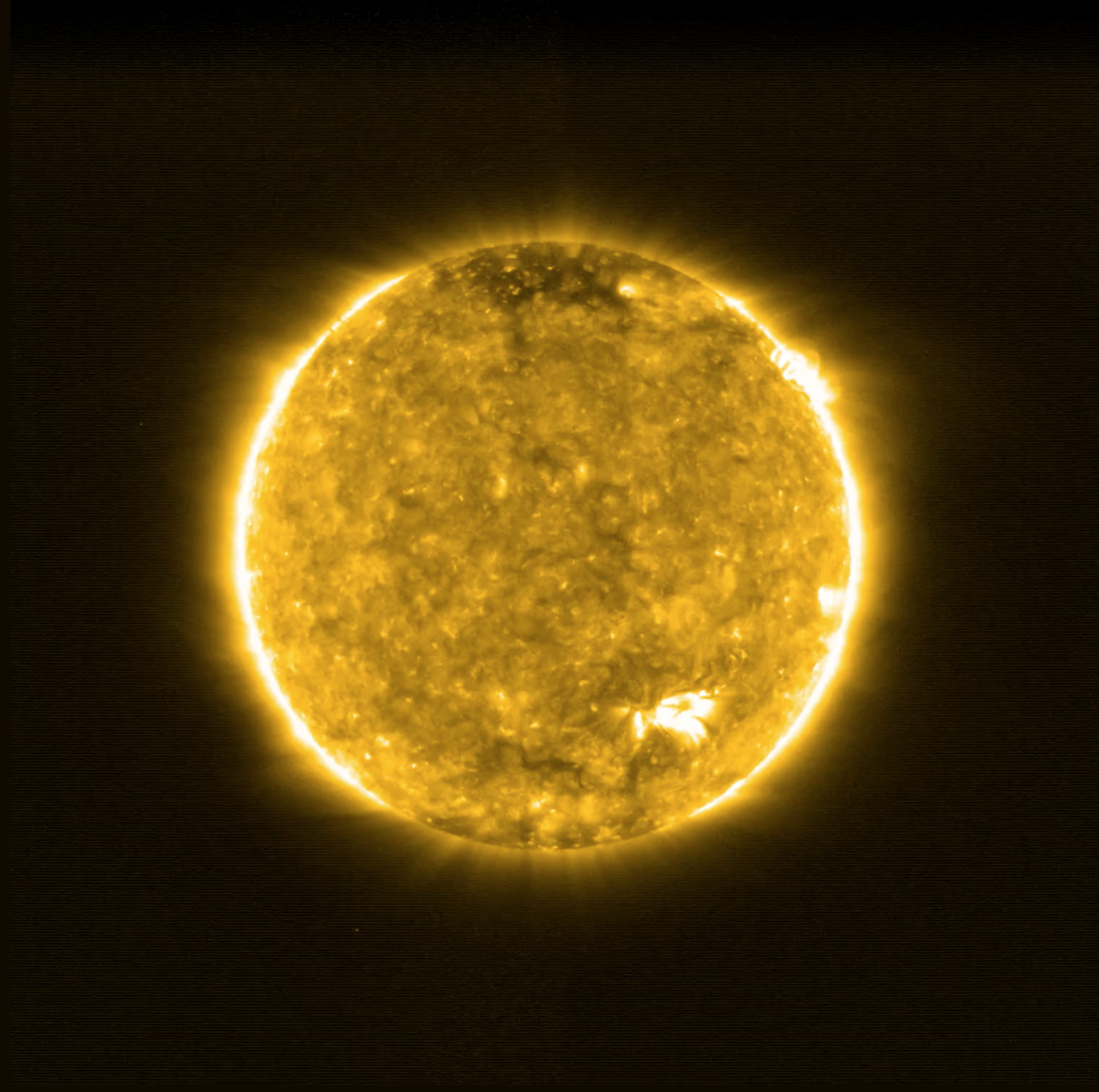
A nuclear fusion reaction takes place when two or more highly energetic atomic nuclei come close enough to form different atomic nuclei and, usually, other subatomic particles as neutrons or protons. Energy is released as a byproduct of the reaction and is due to the difference in mass between the reactants and the resulting products. This process is the main source of energy for stars in their main sequence and constantly transforms light elements into heavier ones, thus creating most of the matter of the Universe.
Various machines to reproduce nuclear fusion reactions in laboratory have been proposed since the 1950s, among which the use of high-powered lasers impinging on a target (“inertial confinement”), and different variants of magnetic confinement devices, such as the stellarator and the tokamak. The tokamak is a toroidal confinement system in which the plasma at high temperature is magnetically confined inside a vacuum chamber by an external magnetic field. Its shape is close to that of a geometrical torus (basically a donut).
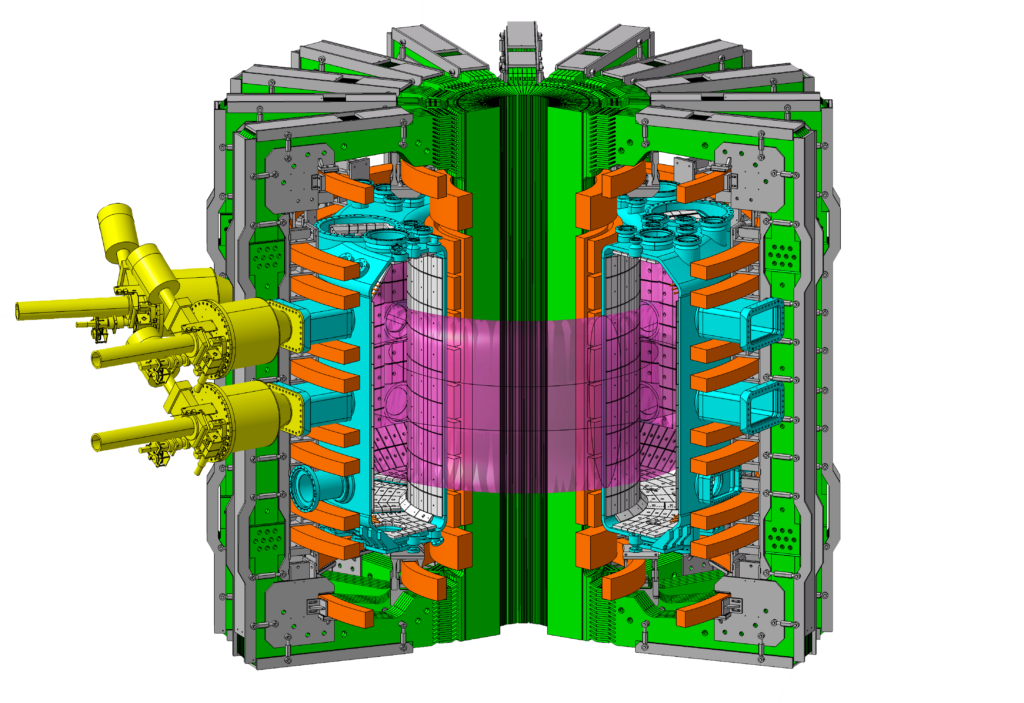
Despite the steady theoretical and technological progresses in the physics of fusion plasmas, nuclear fusion in the laboratory has not been achieved yet and many aspects of the plasma dynamics in fusion machines are still unresolved.
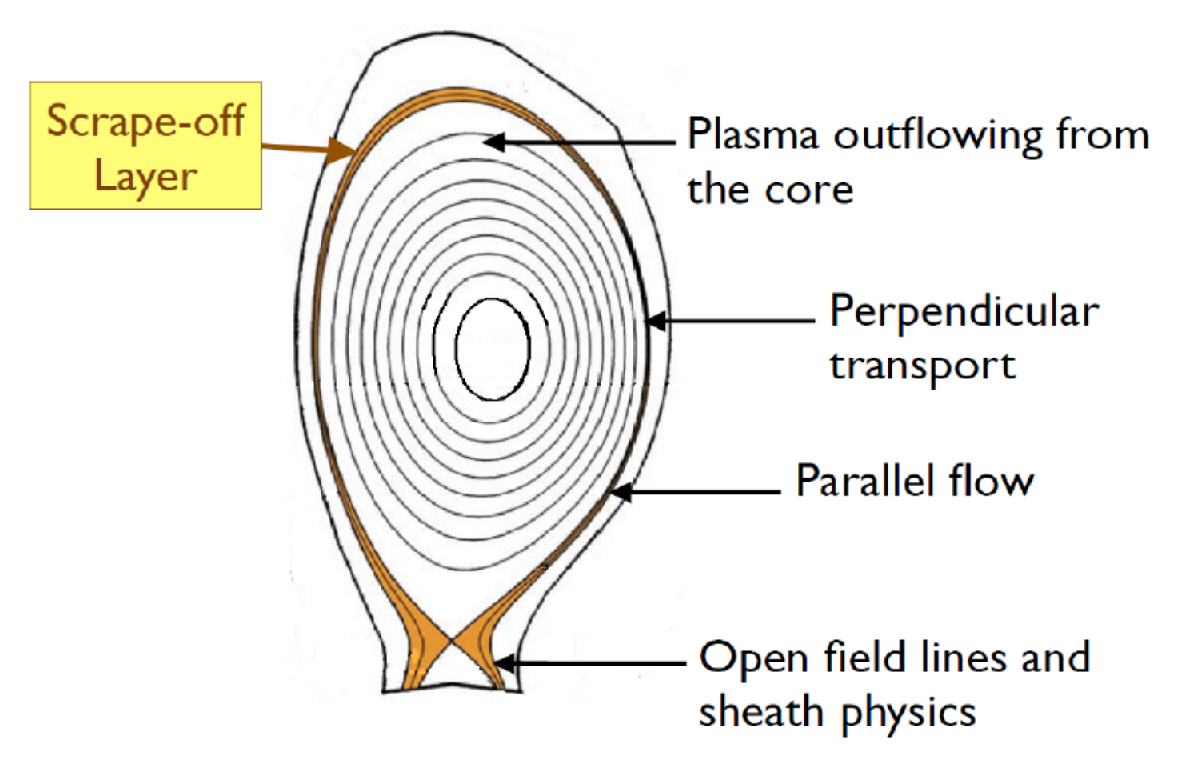
In particular, the processes that regulate the behaviour of the plasma in the periphery region of tokamaks and specifically in the scrape-off-layer (SOL) play an essential role in the confinement properties and on the overall performances of the machine. In this region, however, the plasma shows high levels of turbulence and the interaction with the walls of the vessel produces highly complex phenomena, such as plasma outflows, particle recycling and impurities production, that pose a major challenge to our understanding of the plasma behaviour.
To properly model the kinetic effects described above in the edge region, it is necessary to use kinetic models that deal with the distribution function directly (the Vlasov-Boltzmann equation):
$$ \frac{ \partial f}{\partial t} + \bm v \bm \cdot \frac{\partial f}{\partial \bm x} + \frac{q}{m} \left( \bm E + \frac{\bm v \times \bm B}{c} \right) \bm \cdot \frac{\partial f}{\partial \bm v} = \left. \frac{ \partial f}{\partial t} \right|_c $$ where the one-particle distribution function $f (\bm x, \bm v, t)$ represents the probability of finding any particle of a given species at position $\bm x$ and velocity $\bm v$, and where the right-hand side describes the effect of particle collisions. Since plasmas are magnetized, the Vlasov-Boltzmann equation is complemented by Maxwell’s equations for electromagnetism that describe the evolution of the electric $\bm E$ and magnetic fields $\bm B$.
In general, two main numerical approaches have been developed to solve the Vlasov-Boltzmann equation:
- Eulerian methods based on the discretization of Vlasov-Boltzmann equation, which is the equation that determines the evolution of the distribution function in the six-dimensional phase-space,
- “particle-in-cell” (PIC) methods where pseudo-particles (that are computational objectsthat represent a large number of real particles) are evolved on a grid, called “mesh”, and used to compute electro-magnetic potentials consistently.
The drift-kinetic theory
In this project, I derived an analytical model to describe the physics of the SOL based on the drift-kinetic (DK) approximation and on a polynomial expansion of the distribution function in the perpendicular velocity, hence the denomination of 4-dimensional drift-kinetic model. The theory of drift-kinetic allows us to analyze the dynamics on scales larger than the ion gyroradius, while the polynomial expansion provides a powerful tool in the study of Boltzmann equation and is well-suited to describe energy transport in the phase-space.
To obtain the drift-kinetic equation we first change into a system of coordinates that follows the gyrocenter of the particle $\bm R$ (rather than the particle’s position itself), and average over one orbit of the particle around the magnetic field. The resulting equation reads:
$$ \frac{ \partial \langle F \rangle}{\partial t} + \bm{\dot{R}} \bm \cdot \frac{\partial \langle F \rangle}{\partial \bm x} + \dot{v}_{\parallel} \frac{\partial \langle F \rangle}{\partial v _\parallel} = \langle C(F) \rangle $$
where the dot represents the time derivative, and $v _\parallel$ is the parallel velocity along the magnetic field direction.
Perpendicular moment expansion
Rather than solving the drift-kinetic equation directly, we expand it in Laguerre polynomials $L_j (x)$ that are function of the perpendicular velocity, and integrate them, which reduces the dimensionality of the phase-space from 5 to 4 dimensions. The Laguerre polynomials form a complete set of orthogonal polynomials over $[0, \infty)$ with respect with the weight $e^{-x}$. Any function which is square-integrable over this interval can be formally decomposed in Laguerre polynomials, similarly to a Fourier series. Expanding the drift-kinetic distribution function $\langle F \rangle$ in Laguerre polynomials and integrating, one obtains a system of coupled equations for the coefficients of the expansion $N^j$, in which the $j$-th equation depends on the $j+1$ and $j-1$ equations (without considering Coulomb collisions).
The role of collisions
Collisions - or random particle interactions - play an essential role in the evolution of the distribution function, but they are in general very hard to treat. In general, a physical collision operator should satisfy some basic properties, irrespective of the exact mechanism of scattering. A collision operator should reflect classical dissipation by making the entropy increase in all cases, except when the plasma is at thermodynamic equilibrium, given by a Maxwellian distribution. The collision operator should conserve physical quantities such as number of particles, momentum and energy.
The Coulomb collision operator describes “grazing” collision between particles (i.e., small-angle scattering) and satisfies all of the properties listed above. However, its mathematical complexity makes it often intractable for most of the analytical studies of the kinetic equation. For this reason, many have tried to derive simpler collision operators that satisfy all or most of the physical requirements and are easier to handle. For example the Lenard-Bernstein-Dougherty collision operator has a very simple form:
$$ C [f] = \nu \frac{\partial }{\partial \bm v} \left[ (\bm v - \bm U) f + \frac{T}{m} \frac{\partial f}{\partial \bm v} \right] $$
which has the form of a Fokker-Planck diffusion operator in velocity space ($\bm U$ is the bulk velocity of the plasma, $T$ its temperature, and $m$ the particle mass). Expanding the Lenard-Bernstein-Dougherty collision operator in Laguerre polynomials and integrating in the perpendicular direction shows that the $j$-th term of the expansion actually does not depend on any other lower- or higher-order moments. In plasma kinetics one says that there is no phase-mixing associated with this operator. Mathematically speaking the Laguerre polynomials are eigenfunctions of the anisotropic fluid collision operator. The Coulomb collision operator is not that nice unfortunately, and the $j$-th moment depends on all the others in an infinite series. The problem can be simplified if one looks at the linearized version of the Coulomb operator, or in the small mass-ratio regime.
Nevertheless, the 4-dimensional model is still rather complex. One simplifying assumption is to truncate the moment hierarchy in the perpendicular velocity at the lowest order (one-moment model), which retains the full dependence on the parallel velocity and, therefore, it could be used effectively to describe transport along the magnetic field lines and boundary conditions at the sheath entrance.
Publications related to this project
1. ‘‘Four-dimensional drift-kinetic model for scrape-off layer plasmas’’, Perrone, L. M.; Jorge, R.; Ricci, P., Physics of Plasmas, Volume 27, Issue 11, article id.112502. ADS