Turbulence in Galaxy Clusters
In this project, I aim to clarify how turbulence is excited in the hot plasma of the intracluster medium (ICM) using large-scale cosmological simulations. There is however a fundamental issue: since the plasma is continuously stirred by different processes on disparate scales (from megaparsecs potentially all the way down to nanoparsecs), disentangling turbulence and bulk motions is inherently ambiguous. This poses a serious problem when we want to interpret observations and numerical simulations! In this project I use filtering operators (smoothing kernels) to separate fluctuations at different scales, and I applied them to a cosmological simulation of a major merger of two massive cluster of galaxies. By using definitions of large- and small-scale turbulent energies from turbulent theory (large-eddy simulations), I then study how turbulent energy evolves with time and compare it to observations with X-ray telescopes.
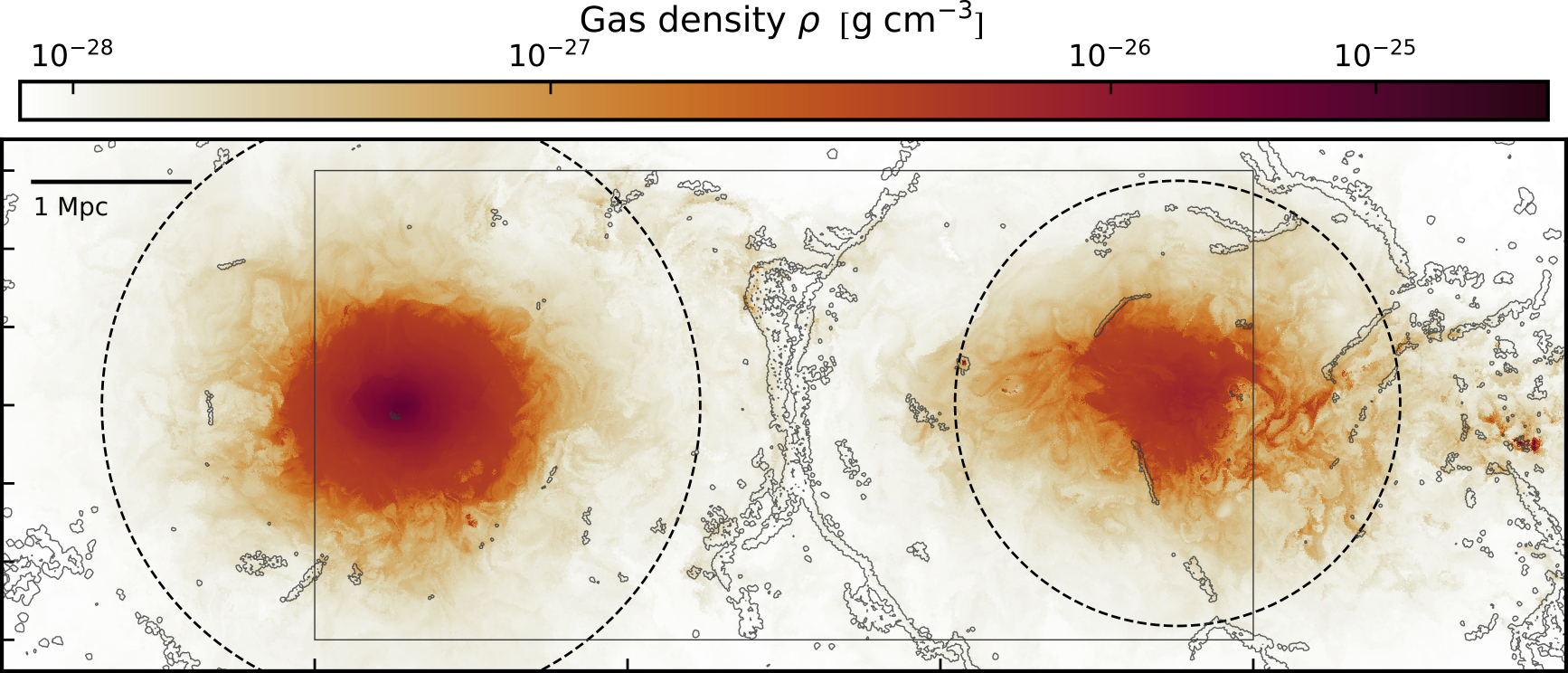
Smoothing filters
Smoothing filters are routinely used in computer graphics and signal processing to isolate the low- or high-frequency components. The basic idea is to convolve the signal with a kernel, for example a Gaussian, a top-hat, and so forth, which weighs nearby regions more than things further away. If you see it in Fourier space, it is equivalent to smoothing the original data. Here is an example when I apply a smoothing filter to the density field of a galaxy clusters:
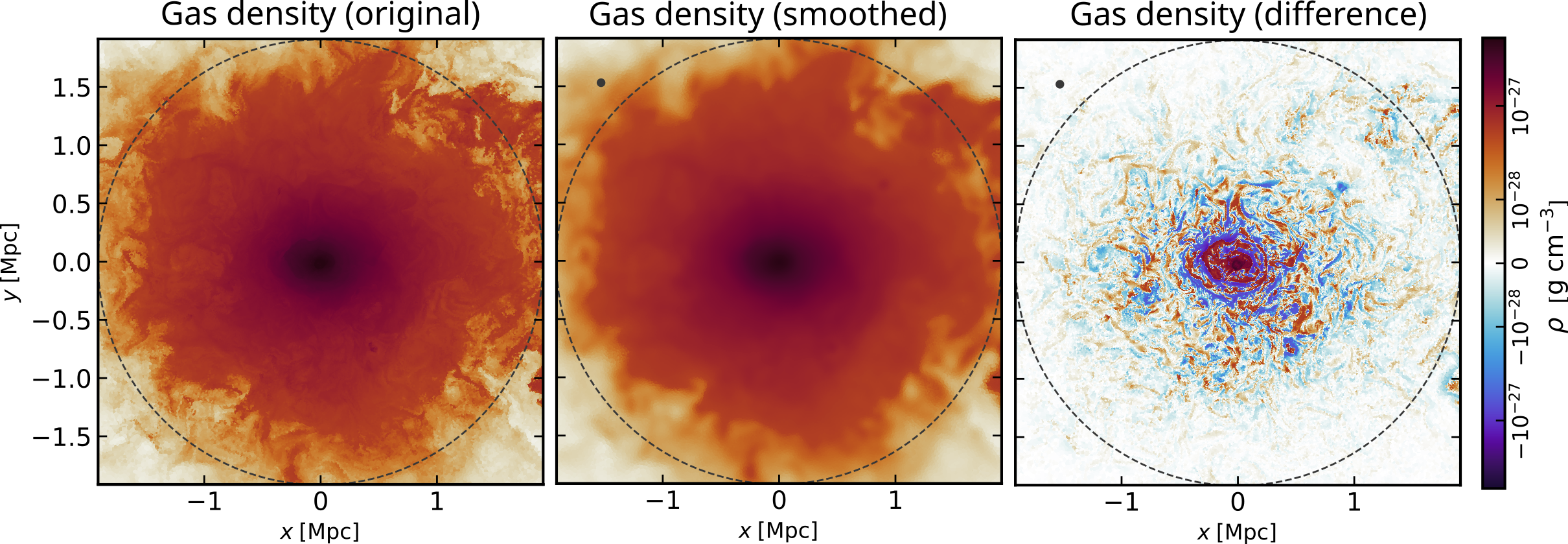
In particular, the difference between the original and the smoothed density represents small-scale fluctuations that one could roughly identify with “turbulence”. By changing the size of the kernel, we can extract fluctuations on different scales, and in this way have a better overview of the properties of the turbulence in different regions of the cluster and during the merger.
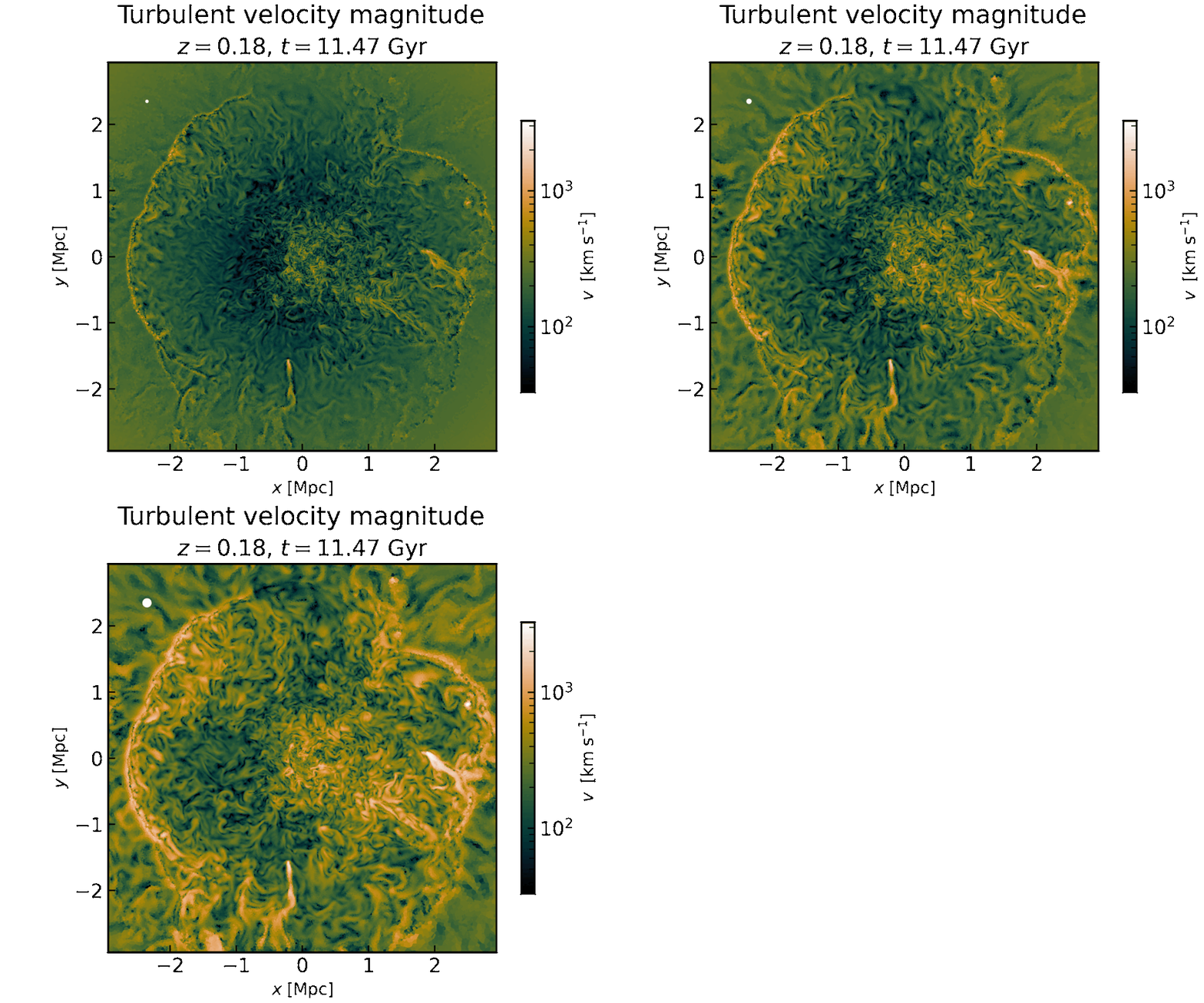
Numerical implementation
The operation of convolution is computationally expensive to perform in real space for large number of cells/particles (of the order of 70+ millions), and I wanted to avoid using Fourier methods for different reasons: first of all, the regions of space I am interested in are not periodic; second, I want to use the full resolution of the simulation in the high-resolution regions and not having to interpolate on a coarser grid.
For this reason, it was necessary to implement the smoothing filters in a new Python library called Turbocluster, which uses NVIDIA graphical processing units (GPUs) to speed up computations using the Numba library. This code is originally written to interface with Arepo data outputs, which is a moving-mesh code that evolves the comoving form of the ideal MHD equations, but it could be in theory extended to any data format that can be read in as a set of cell positions, volumes and associated physical quantities to be smoothed (e.g. density, velocity field, …). I am planning to release the Turbocluster library publicly in the near future. The simulations of the galaxy clusters were performed by my collaborator Dr. Thomas Berlok.
Turbulent energies
With the filtering approach, one has to efine turbulent and bulk energies that are both mathematically sound and physically meaningful. The solution comes from the generalized statistical moments of turbulent fields, which constitutes the cornerstone of large-eddy simulations (LES) of hydrodynamic turbulence. We need second- and third-order statistical moments $\mu_2(f, g)$ and $\mu_3(f, g, h)$, defined as
$$ \begin{aligned} \mu_2(f, g) &= \langle f g \rangle_\ell - \langle f \rangle_\ell \langle g \rangle_\ell, \\ \mu_3(f, g, h) &= \langle f g h \rangle_\ell - \langle f \rangle_\ell \mu_2(g,h) - \langle g \rangle_\ell \mu_2(h,f) - \langle h \rangle_\ell \mu_2(f,g)- \langle f \rangle_\ell \langle g \rangle_\ell \langle h \rangle_\ell, \end{aligned} $$
where $f(\bm x)$, $g (\bm x)$, $h(\bm x)$ are generic turbulent fields. Using these statistical moments it is possible to define generalized turbulent energies, as well as their evolution equations. The connection with LES methods becomes very clear, as the tensor $\mu_2(u_i, u_j)$ is effectively the same as the subgrid-scale stress tensor. Here below is an example of what the bulk and turbulent kinetic energy densities before the merger look like:
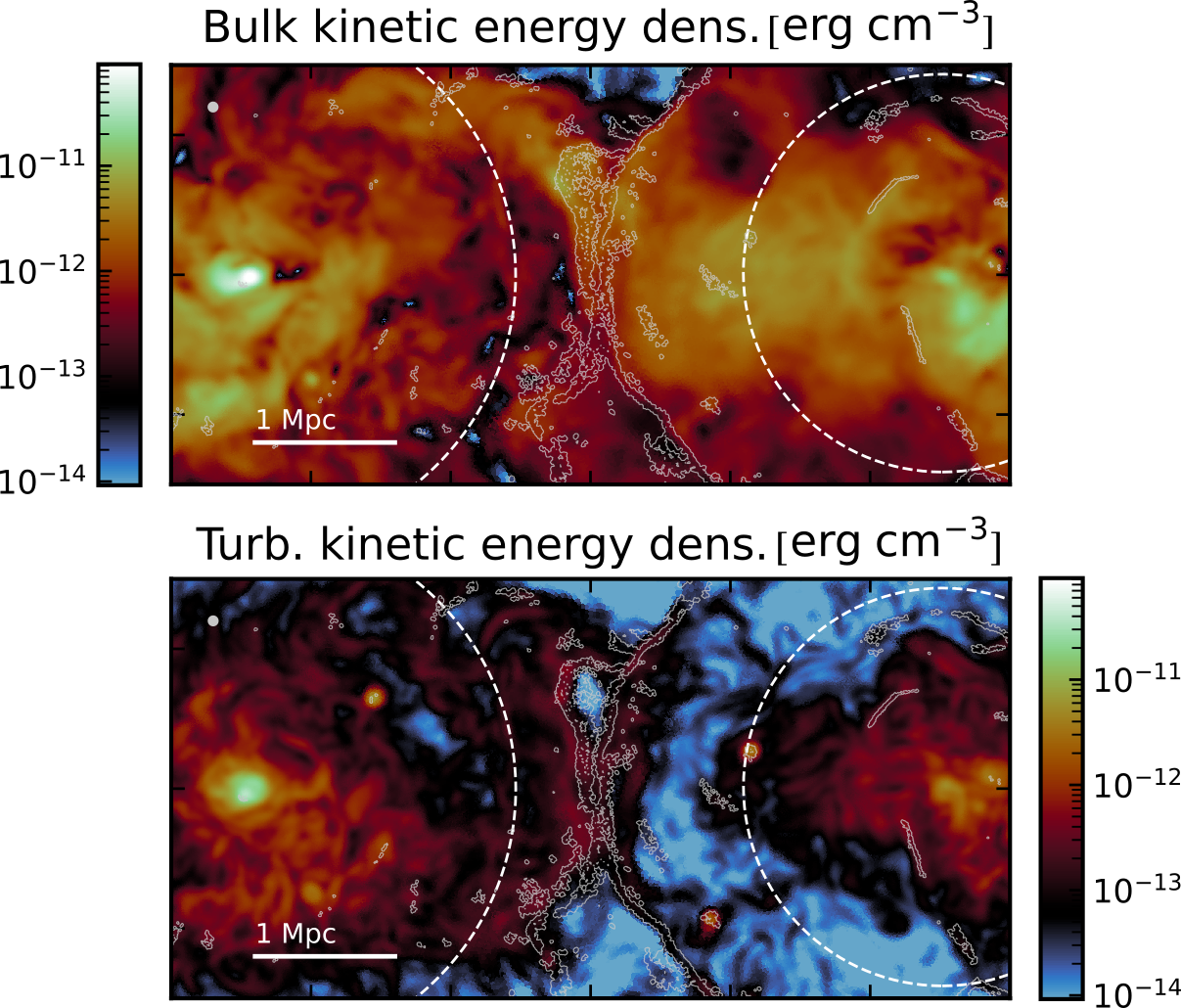
Note the large values of the bulk kinetic energy in the region between the two clusters associated with the cluster infall, which is not present in the turbulent kinetic energy density.
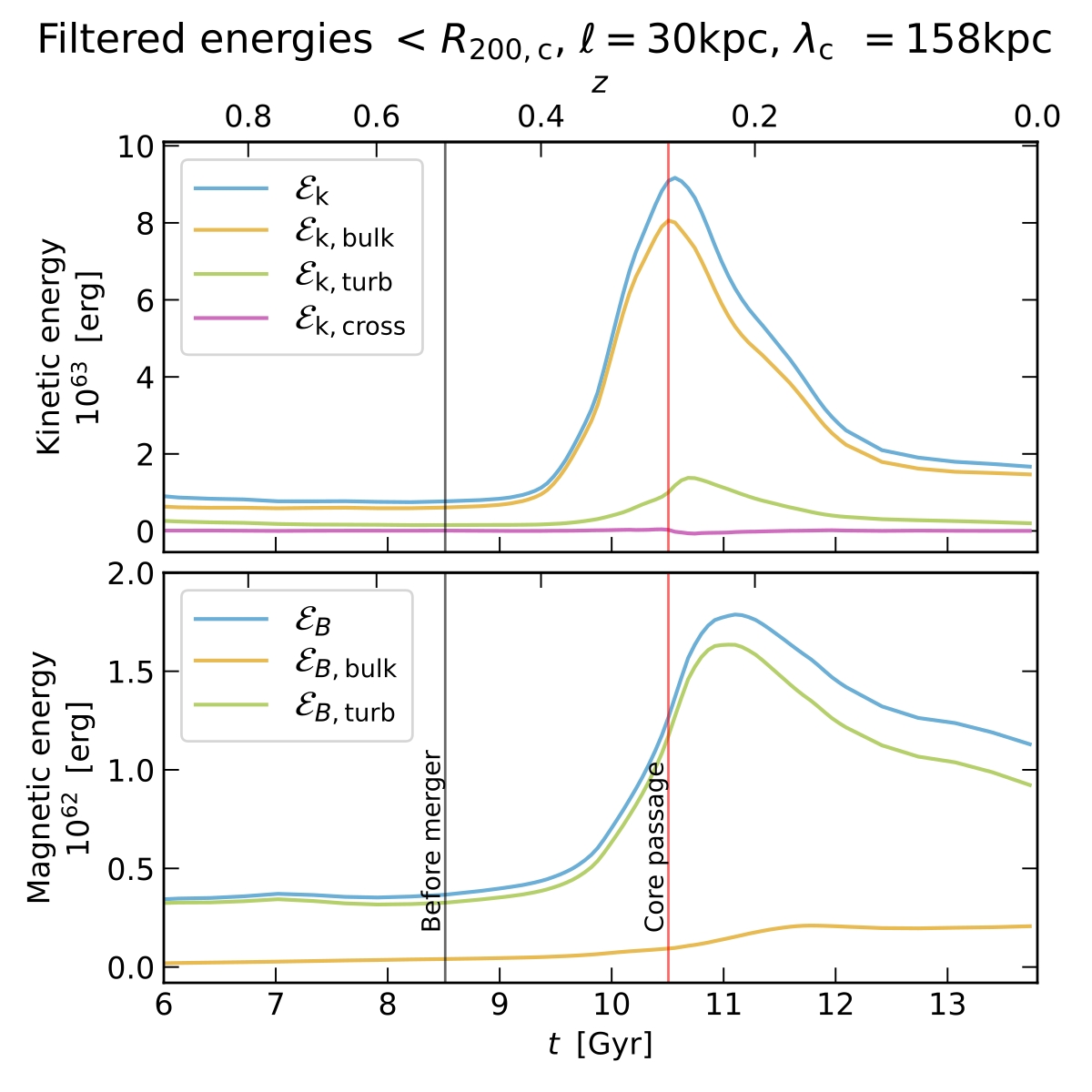
Now that we have a way to construct bulk and turbulent kinetic and magnetic energies, we can follow their evolution in time through the major merger, shown in the plot below for a fiducial filter scale (30 kpc). Most of the kinetic energy resides in the bulk flow rather than the turbulent component, while the reverse is true for the magnetic energy.
Nevertheless, during the merger the total, bulk and turbulent kinetic energies increase substantially by roughly a factor of ten, albeit at different rates.
The magnetic energy is instead amplified by a factor of five, similar for both the bulk and turbulent components. Interestingly, the turbulent magnetic energy reaches its peak slightly delayed with respect to the turbulent kinetic energy ($\simeq$ 300 Myr), and decays more slowly afterwards.
Conclusions
To compare the levels of turbulence detected with the filtering approach with other methods and with observations, I compute the turbulent kinetic pressure fraction $f_{\mathrm{k,turb}}$, $$ \begin{align} f_{\mathrm{k,turb}} = \frac{ p_{\mathrm{turb}}}{ p_{\mathrm{turb}} + p_{\mathrm{th}}}, \end{align} $$ within $R_{200,\mathrm{c}}$ and for the different filter scales. Its evolution is shown below for the three filter lengths considered. There is a sharp exponential-like increase of the turbulent pressure fraction during the merger that peaks near the core passage; the subsequent relaxation takes place in two phases: a first rapid decrease, followed by a slower decline. For the fiducial filter length $\ell = 30$kpc the kinetic turbulent fraction reaches $f_{\mathrm{k,turb}} \simeq 5 %$ near the core passage. For larger filter scales these numbers tend to increase, but even for the largest scale probed, $\ell \simeq 60$kpc, where $f_{\mathrm{k,turb}} \simeq 9$% during the core passage, the kinetic turbulent fraction quickly decreases to $\simeq 3.5$% after 1.5 billion years.
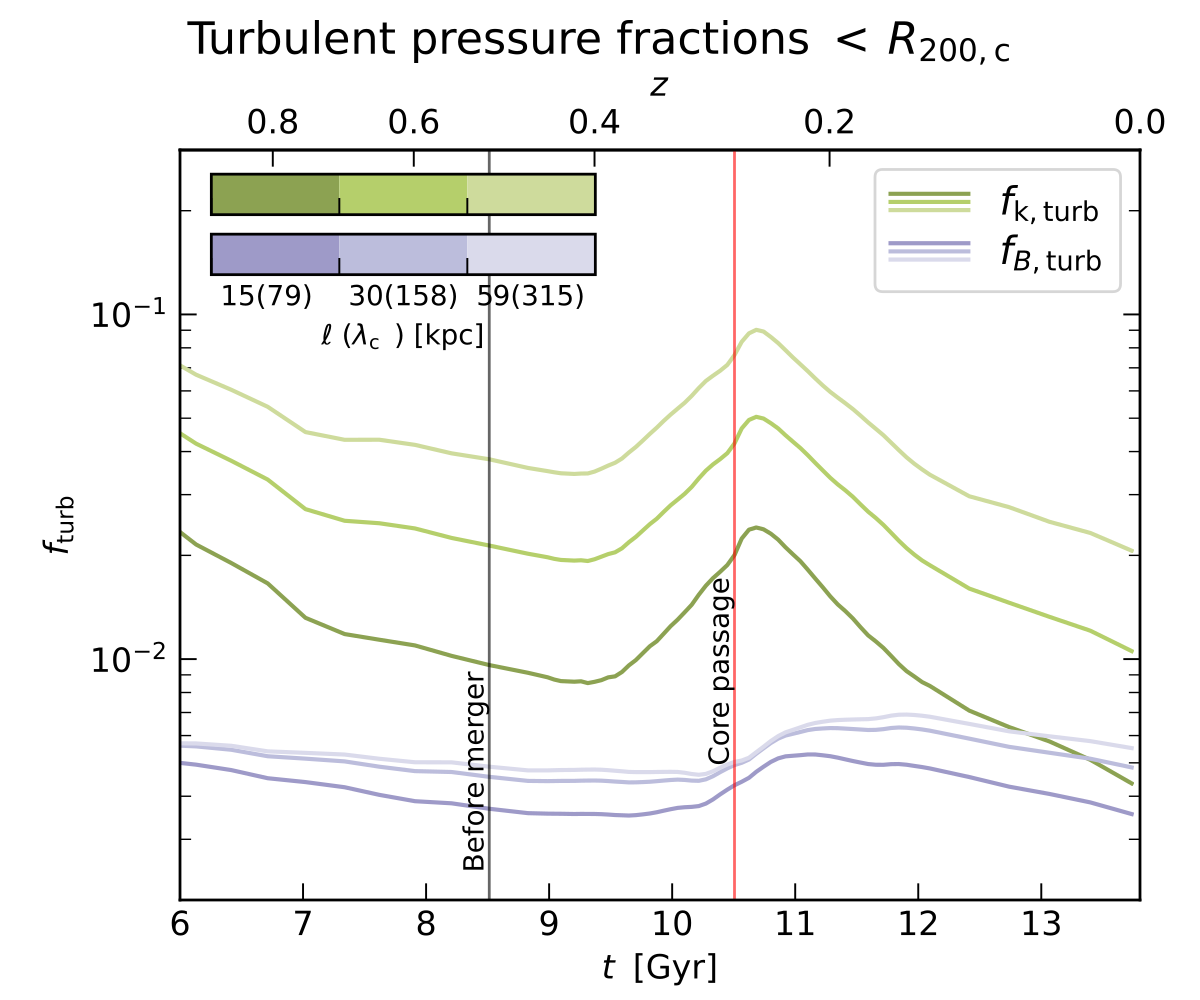
These results suggest that, unless a cluster has undergone a major merger within the last $1-1.5$Gyr, values of $2-3%$ for the turbulent kinetic pressure fraction are not unusual, provided one carefully removes large-scale bulk motions. These low values are consistent with recent observations of nearby massive clusters with the X-ray telescope XRISM. A more in-depth comparison with observations is planned for future work.
Publications related to this project
1. ‘‘Characterizing turbulence in galaxy clusters: defining turbulent energies and assessing multi-scale versus fixed-scale filters’’, Perrone Lorenzo Maria et al., under review by Astronomy&Astrophysics. Available here.