Thermal conductivity with bells and whistlers
The hot and dilute intracluster medium (ICM) in galaxy clusters is a rather interesting plasma, from a physical point of view. First of all, it is weakly collisional, which means that ions and electrons interact infrequently compared to the typical dynamical timescales of the system and the plasma may not necessarily in local thermodynamic equillibrium. Second, magnetic fields are generally subthermal, making it a high-$\beta$ plasma ($\beta = p_{\mathrm{th}}/ (B^2 / 8 \pi)$ is the ratio of thermal to magnetic pressure). As is well known in plasma physics, in weakly-collisional high-$\beta$ plasmas it is easy to excite microinstabilities that grow on very fast timescales ($10^{-2}–10^2$ s), and on very short scales comparable to the Larmor radii of charged particles (of the order of a nanoparsec). Comparing these numbers with typical dynamical processes in galaxy clusters (gravitational accretion, black hole feedback, buoyancy, …) which occur on time- and lengthscales of million of years and tens of kiloparsec, we see that these microinstabilities grow essentially instantaneously!
Impact of microinstabilities
Previous studies showed that the small-scale electromagnetic fluctuations resulting from the growth and saturation of these microinstabilities lead to an enhancement of the scattering rate of charged particles, thus hindering particle transport. These small-scale processes can then feed back on the large-scale dynamics of the ICM, for example by reducing the effective viscosity and suppressing thermal conductivity.
This property of dilute magnetized plasmas may help explain the presence of features such as cold fronts, which are characterized by sharp temperature gradients on spatial scales comparable or shorter than the electron mean-free path.
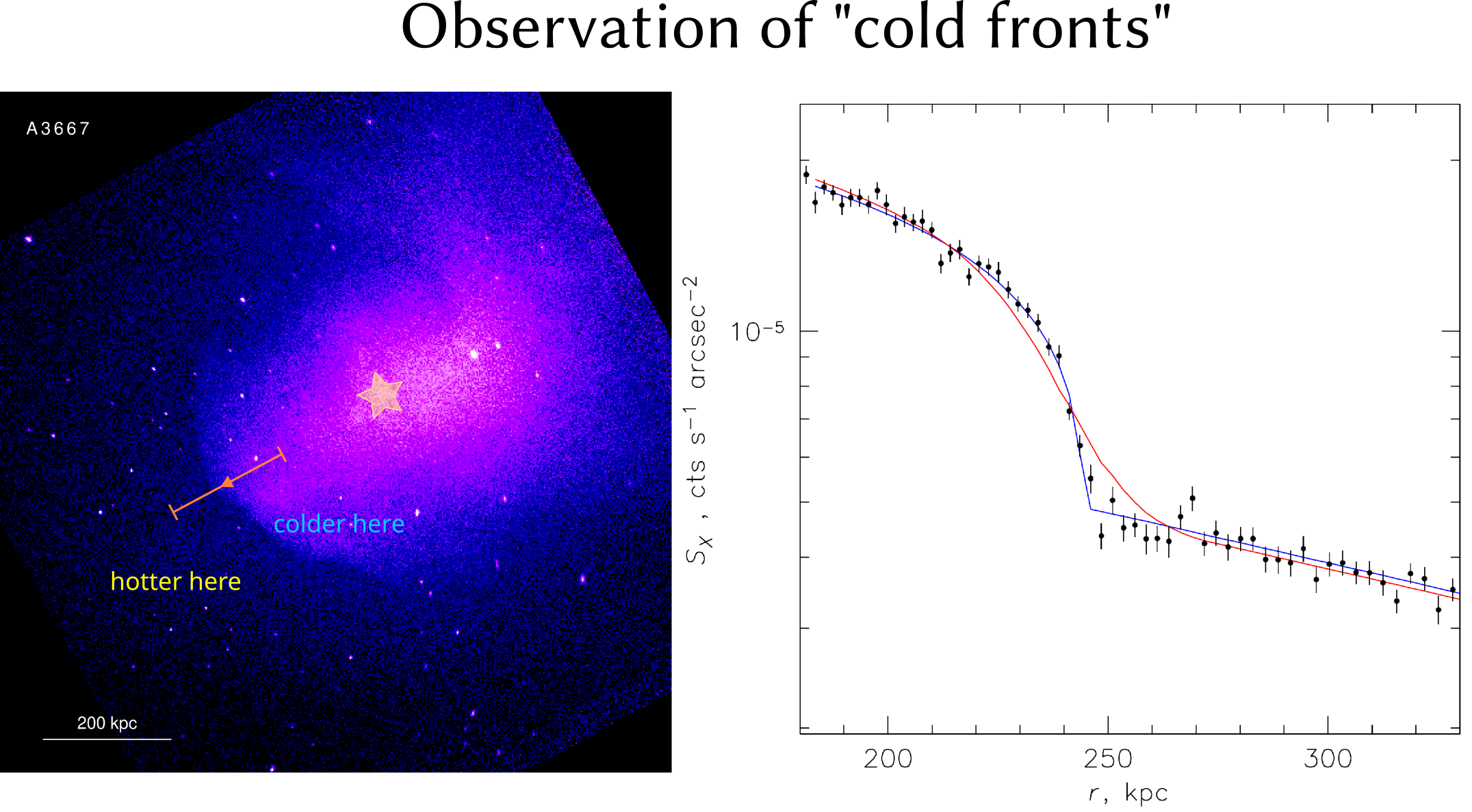
Unfortunately predicting theoretically the impact of microscale instabilities is not straightforward, and numerical simulations that model this cross-talk between small and large scales self-consistently are currently unfeasible due to the vast scale separation. For this reason, one viable approach to capture the effect of individual microinstabilities is to devise effective models inspired by kinetic physics that can be used in large-scale simulations. This is the approach that I also adopted in this project, where I investigated the impact of one such microinstability, the whistler instability, that is thought to suppress heat conduction in the ICM. In particular, I studied the effect of the whistler instability on an magnetohydrodynamic instability, the MTI (magneto-thermal instability), that I previously studied in my PhD, and that relies on fast conduction along magnetic field lines.
The fact that the MTI drives turbulent motions whose strength scales with the value of thermal diffusivity make it an excellent candidate to study the impact of whistler suppression of thermal conduction on the large scales.
Subgrid closure for whistler-suppression of thermal conductivity
In the standard picture of transport processes in plasmas, transport of heat is mediated by particle-particle Coulomb collisions, with thermal electrons of temperature $T_\mathrm{e}$ and density $n_\mathrm{e}$ scattering off each other. This gives the so-called Spitzer diffusivity
$$ \begin{align*} \chi_{0} \simeq 4.98 \times 10^{31} \left( \frac{T_\mathrm{e}}{5 ~\mathrm{keV}}\right)^{5/2} \left( \frac{n_\mathrm{e}}{10^{-3}~\mathrm{cm^{-3}}}\right)^{-1} \mathrm{cm^2~s^{-1}}. \end{align*} $$
Since heat transport is anisotropic with respect to the local direction of the magnetic field $\bm b = \bm B / B$, the anisotropic (or Braginskii) heat flux along the magnetic field takes the form:
$$ \begin{align*} q_{\parallel,\mathrm{s}} \simeq n_\mathrm{e} \chi_0 (\bm b \bm \cdot \bm \nabla ) T_\mathrm{e}, \end{align*} $$
which means that only temperature gradients along the magnetic field can be thermalized. Previous studies showed that at saturation the whistler instability establishes a marginal heat flux which is suppressed by a factor of $\sim 1/\beta$ compared to the value it would attain due to the streaming of electrons at the thermal velocity $v_{\mathrm{th},\mathrm{e}}$:
$$ \begin{align*} q_{\parallel,\mathrm{w}} \simeq 1.5 n_\mathrm{e} m_\mathrm{e} v_{\mathrm{th},\mathrm{e}}^3 / \beta_. \end{align*} $$ Since in the ICM $\beta \gtrsim 100$, the suppression of the heat flux could then be quite significant.
To model the saturation of the whistler instability in macroscopic fluid simulations of the MTI, I adopted the following subgrid formula for the heat flux, which smoothly interpolates between the collisional heat flux $q_{\parallel,\mathrm{s}}$ and the marginal heat flux allowed in the whistler-dominated regime $q_{\parallel,\mathrm{w}}$:
$$ \begin{align*} q_{\parallel} = \left( \frac{1}{q_{\parallel,\mathrm{s}}} + \frac{1}{q_{\parallel,\mathrm{w}}} \right)^{-1} = \frac{q_{\parallel,\mathrm{s}}}{1 + \frac{1}{3} \beta \lambda_{\text{mfp,e}}/L_{T,\parallel} }, \end{align*} $$ where $L_{T,\parallel} \equiv \left\lvert \bm b \bm \cdot \bm \nabla \ln T_{\mathrm{e}} \right\rvert^{-1}$ is the temperature gradient scale parallel to the magnetic field, and $\lambda_{\text{mfp,e}}$ is the electron mean-free path.
Numerical methods
To simulate whistler suppression on the MTI I turned to SNOOPY, a pseudo-spectral three-dimensional (3D) MHD code which I used during my PhD and where I included anisotropic heat conduction and implemented the closure for the whistler-suppressed heat diffusivity above. Because of the high nonlinearity in the denominator of the heat flux, I implemented a filter of the whistler-suppressed diffusivity using a two-point harmonic averaging, and I applied a hyperdiffusion operator to the buoyancy equation to avoid Gibbs oscillations at the grid-scale.
In a Boussinesq code like SNOOPY the subgrid closure for the heat flux can be rewritten as follows: $$ \begin{align*} \chi \equiv \dfrac{\chi_0}{1 + \frac{1}{3} \alpha \tilde{\beta} \sigma }, \end{align*} $$
where $\alpha$ is the only tunable parameter in our model, that encodes the physical information of the volume of ICM plasma that we simulate. Larger $\alpha$ means stronger suppression.
Suppression of the MTI
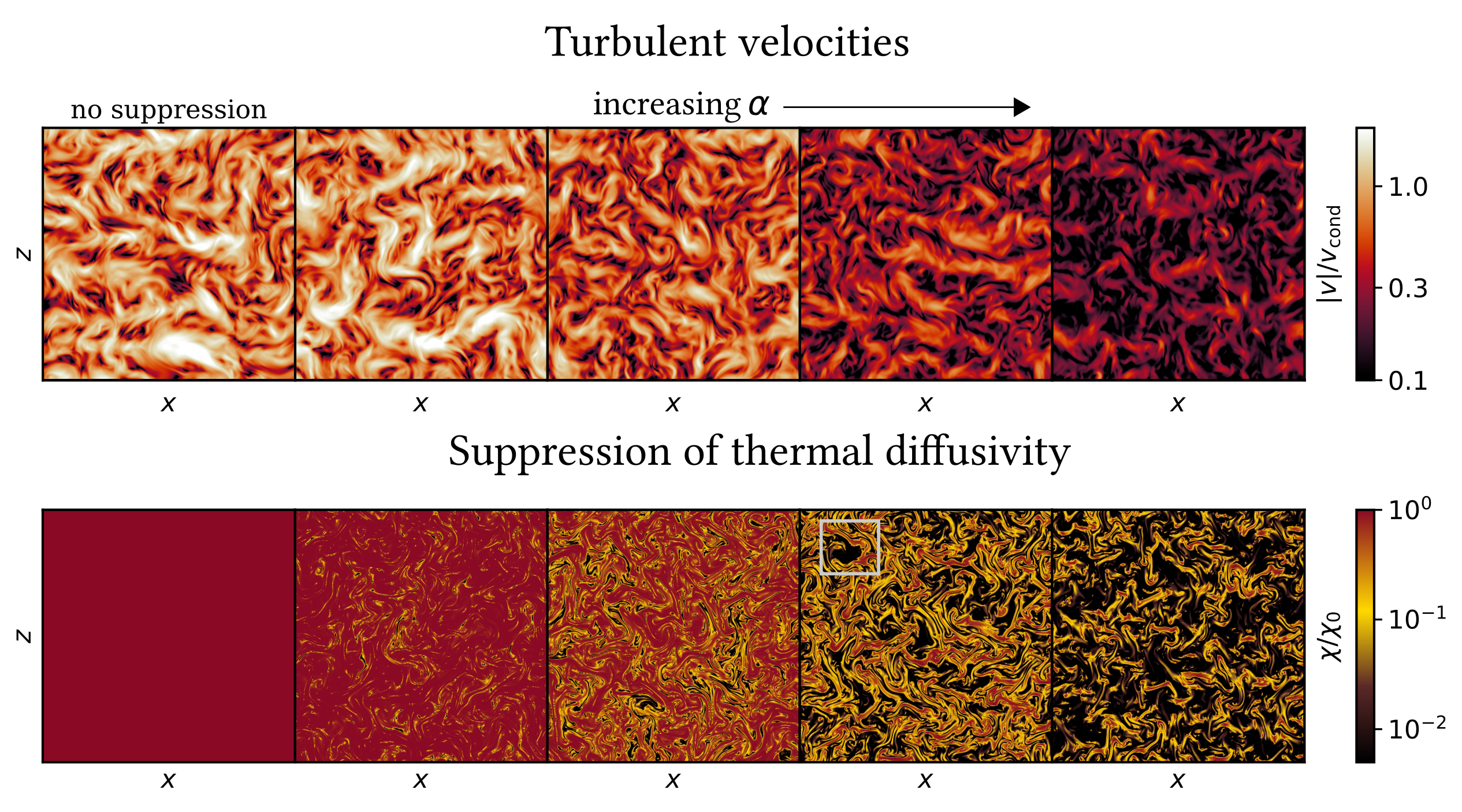
As was expected, introducing whistler suppression (parametrized by $\alpha$) leads to a progressive weakening of the MTI turbulence. This is in spite of the fact that the suppression of thermal diffusion (last row) is not uniform across the domain but is highly inhomogeneous and tends to follow the morphology of the magnetic field.
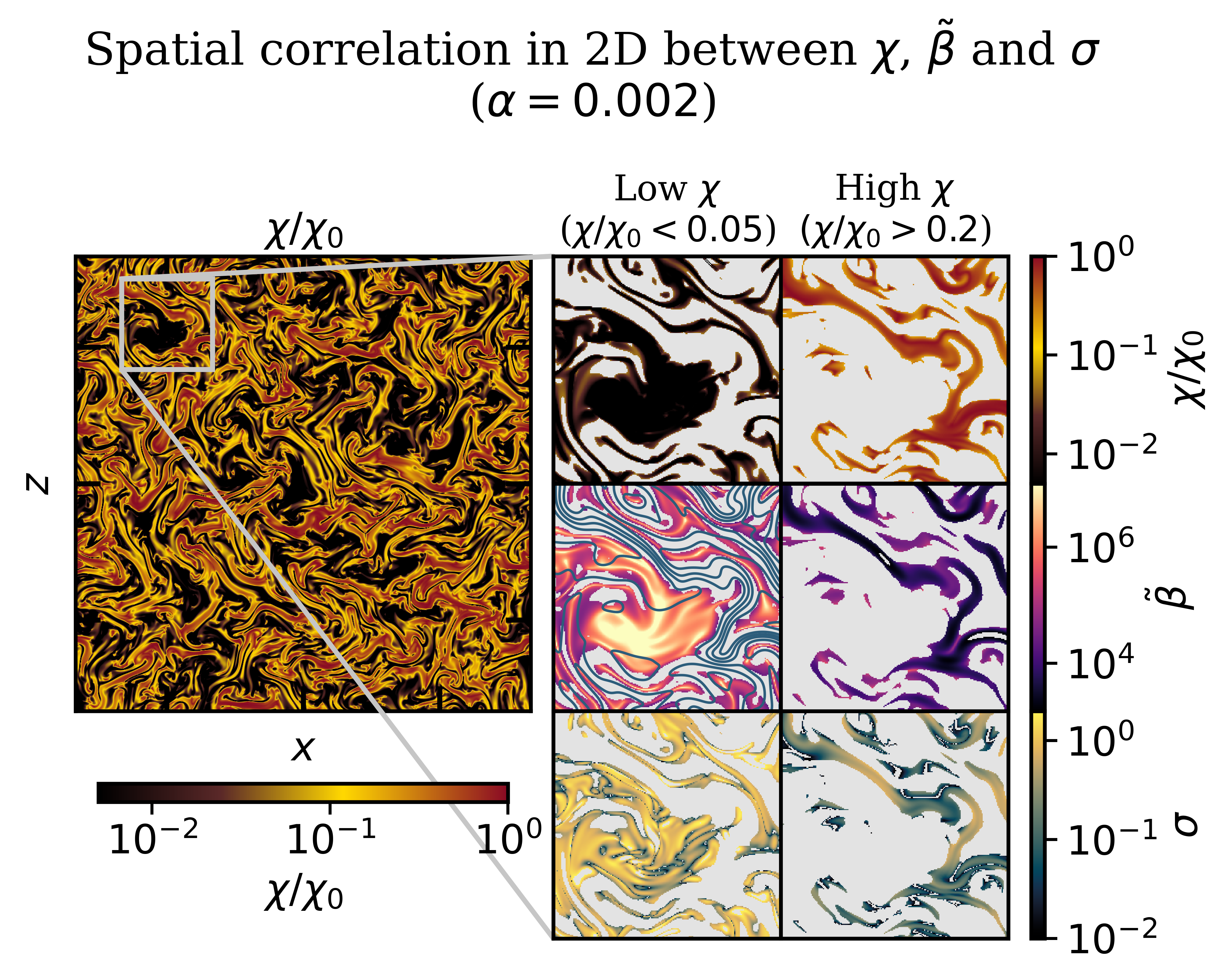
With whistler suppression, regions of high thermal conductivity are shaped as thin bundles near filaments of strong magnetic fields and act in a similar way as Autobahns for the heat-carrying electrons. These snapshots are from 2D runs after they have reached saturation, which allows us to explore a wider range of suppression parameter $\alpha$ than in 3D.
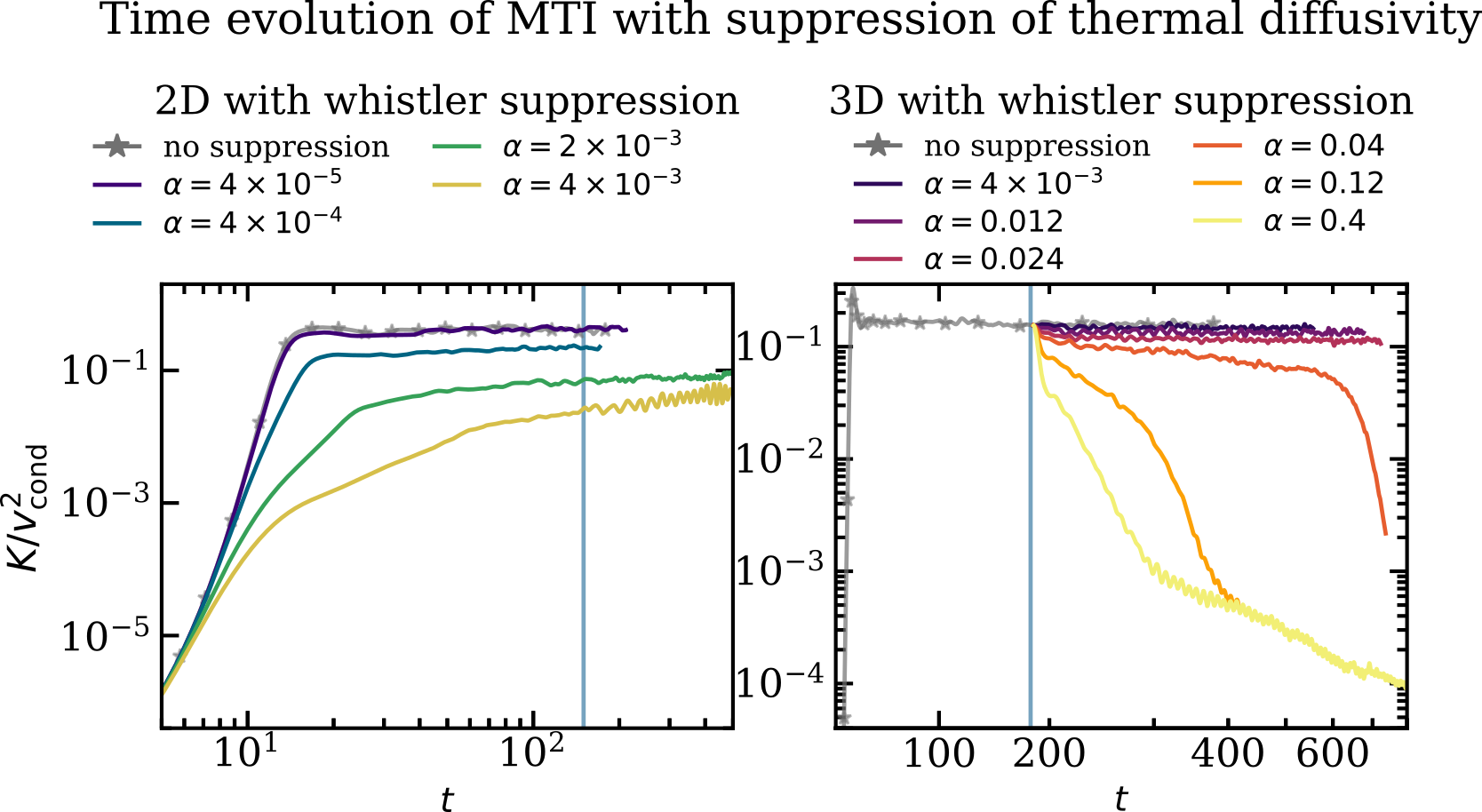
Both 2D and 3D with whistler suppression and with the lowest $\alpha$ there is little difference compared to the reference MTI run, and the final energies are similar. With higher suppression parameter however the behavior between 2D and 3D drastically differs: in 3D beyond a certain value of $\alpha$ the system undergoes a sharp transition and the turbulence dies out! This is asign of a critical transition in whistler-suppressed MTI turbulence and I propose a simple toy model to explain the critical transition between weakened MTI turbulence with whistler suppression and the dead state. The model is based on the role of the MTI-driven magnetic dynamo, and has only two assumptions:
- that at saturation MTI-driven turbulence pins kinetic and magnetic turbulent luctuations approximately at equipartition;
- and that the criterion for an small-scale dynamo (magnetic Reynolds number $\mathrm{Rm}\gtrsim 35$) is fulfilled.
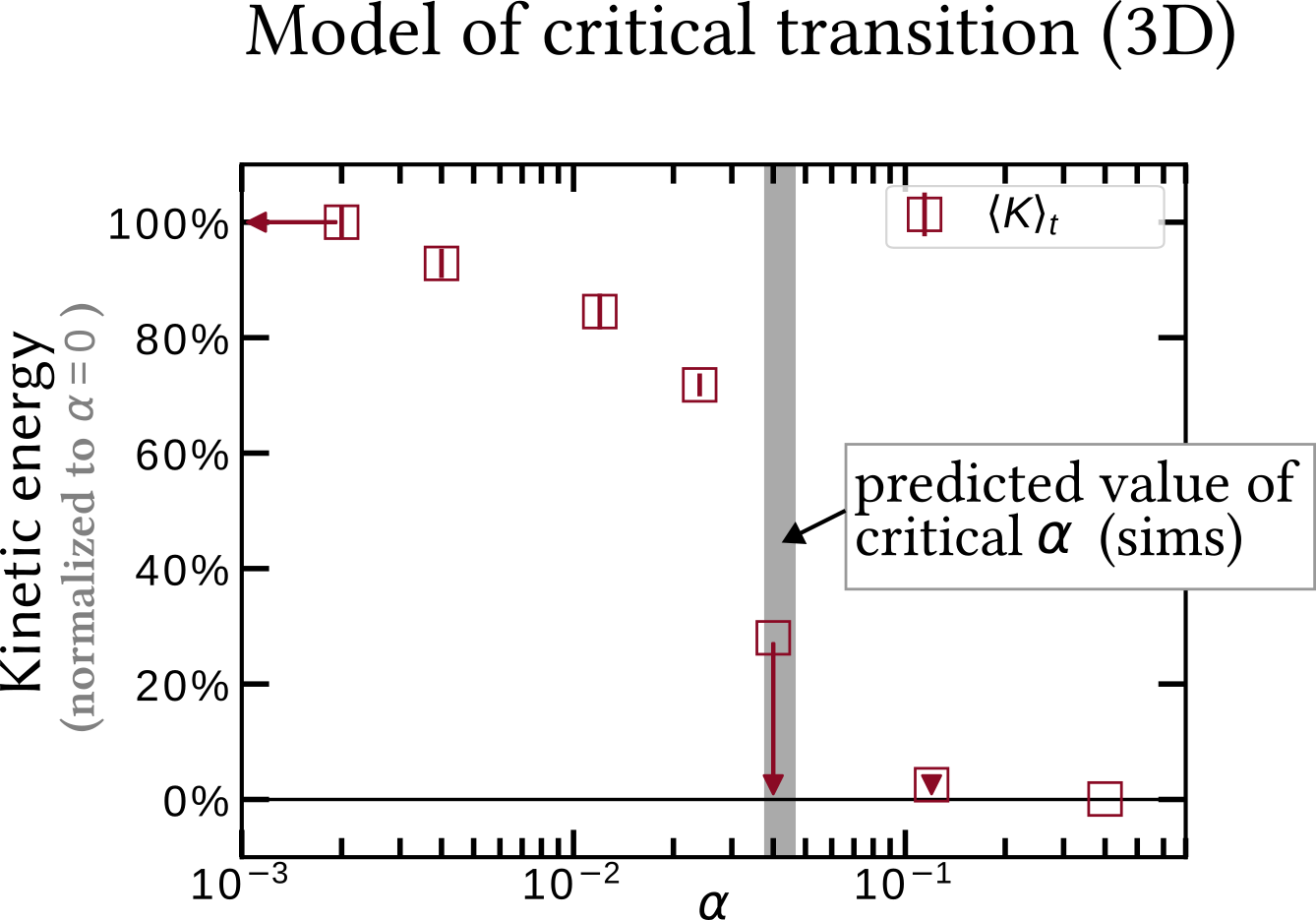
Though simple, this model predicts well the critical value of $\alpha$ that I find from my simulations. Extrapolating to physical conditions of the ICM I find that conditions are such that MTI turbulence might in fact be suppressed.
External turbulence to the rescue
While these results may look disappointing at first, the story gets more complicated. In fact, in the periphery of galaxy clusters other processes are expected to play a role, such as mergers and accretion events. Even in the event of total suppression of the MTI, turbulence in- jected through these other processes can also amplify magnetic fields and, in so doing, restore thermal conductivity to a significant fraction of the Spitzer value. This could make it possible for the MTI to spring back into action.
In the last part of this project I then set out to explore the impact of adding an external source of turbulence to the MTI with whistler suppression.
While the addition of external turbulence somewhat interferes with the MTI, which becomes less efficient at converting thermal energy into turbulence even in the case of no whistler-suppression, external turbulence is able to revive “dead” MTI simulations with strong whistler-suppression, and the flow remains overall buoyantly unstable.
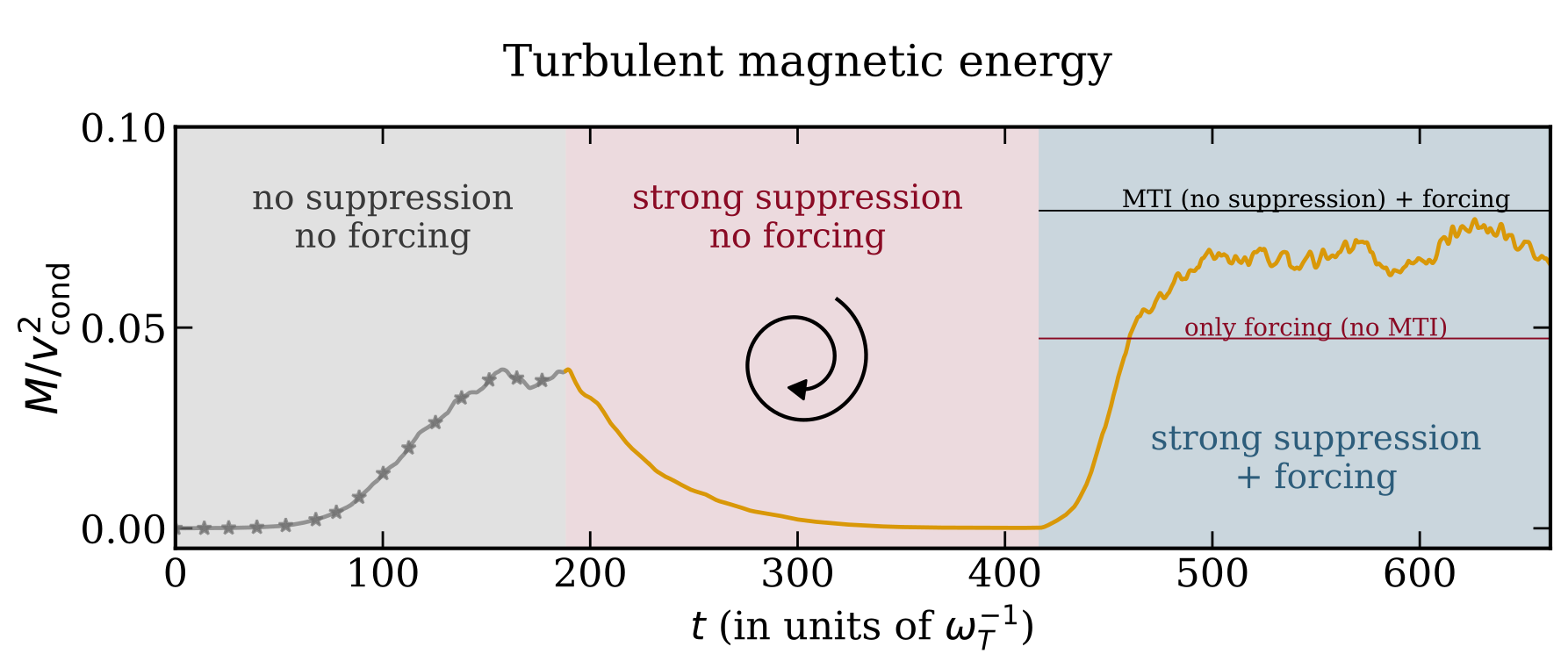
This shows that under certain circumstances the interaction between two sources of turbulence can be con- structive and not necessarily detrimental. Despite earlier assessments, the MTI has proven to be remarkably resilient, I clearly showed that the MTI is a complex dynamical process that requires detailed modeling beyond linear theory in order to draw firm conclusions.
Publications related to this project
1. ''Does the magnetothermal instability survive whistler suppression of thermal conductivity in galaxy clusters? ‘’, Perrone, Lorenzo Maria; Berlok, Thomas; Pfrommer, Christoph, Astronomy & Astrophysics, Volume 682, id.A125, 7 pp. ADS
2. ''Thermal conductivity with bells and whistlers: Suppression of the magnetothermal instability in galaxy clusters ‘’, Perrone, Lorenzo Maria; Berlok, Thomas; Pfrommer, Christoph, Astronomy & Astrophysics, Volume 690, id.A292, 26 pp. ADS